01Home 02Research 03Teaching 04Students 05Products 06News 07Writing 08Platform New 09Contact 10Curriculum Vitae
Blended Teaching Contentby Yasas Sri Wickramasinghe

Lessons you can
actually play with.

I teach four courses in the Master of Business Informatics at Yoobee College, and I've built interactive lessons for all of them. You can run the simulations, work through the labs and take the quizzes right here in your browser. They're free, and there's no account to make or anything to install.

4Postgraduate courses
40Interactive lessons
8Hands-on labs & practice
0Logins or installs needed
The courses

Four courses, one way of teaching.

Each course has its own colour on the lessons site and I've kept the same colours here, so it's easy to tell them apart. Every course page over there also shows which lessons cover which learning outcome.

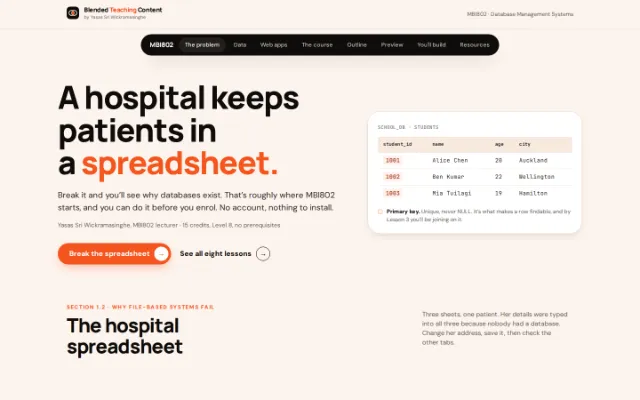
MBI800 9 lessons

Strategic Information Systems Planning

What an organisation decides to build, and why it keeps getting the decision wrong.

  • LO1Read the system you have
  • LO2Weigh culture and privacy
  • LO3Write the plan

15 credits, Level 8, no prerequisites
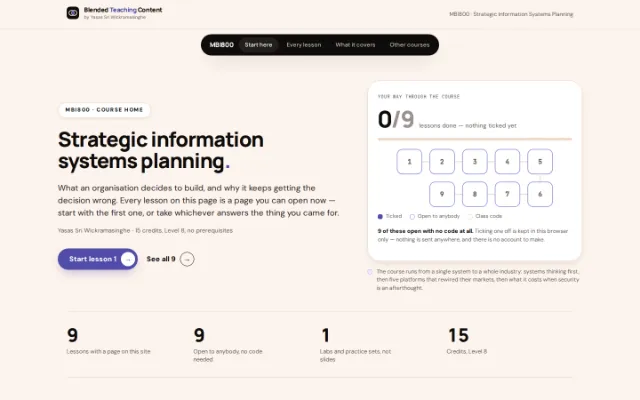
MBI802 17 lessons

Database Management Systems

From a spreadsheet that contradicts itself to a normalised database you can query.

  • Data against information, and why file-based systems fail
  • The relational model and setting up MySQL
  • SQL fundamentals: data types, CREATE, INSERT and your first SELECT

15 credits, Level 8, no prerequisites
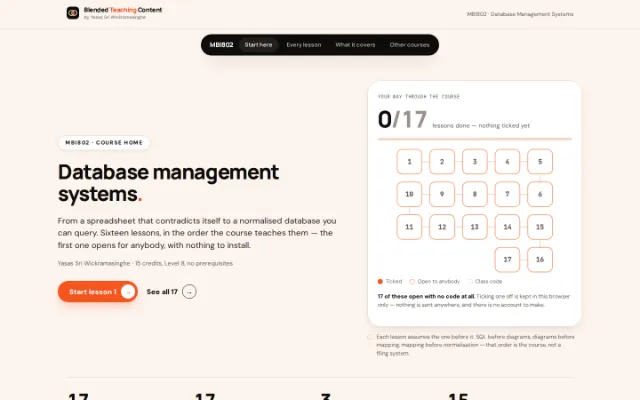
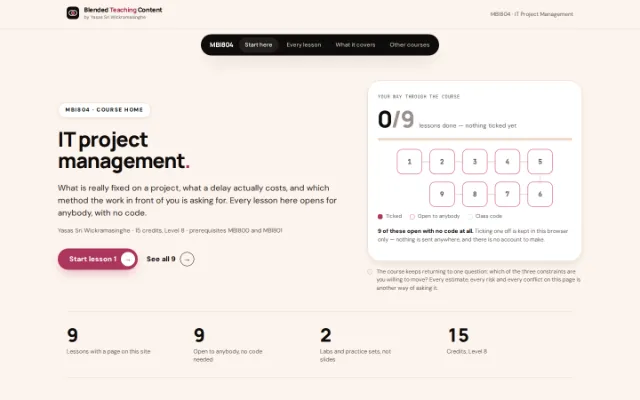
MBI804 9 lessons

IT Project Management

What is really fixed on a project, what a delay actually costs, and which method the work in front of you is asking for.

  • LO1Choose the method
  • LO2Name the risks
  • LO3Run it in your field

15 credits, Level 8 · prerequisites MBI800 and MBI801
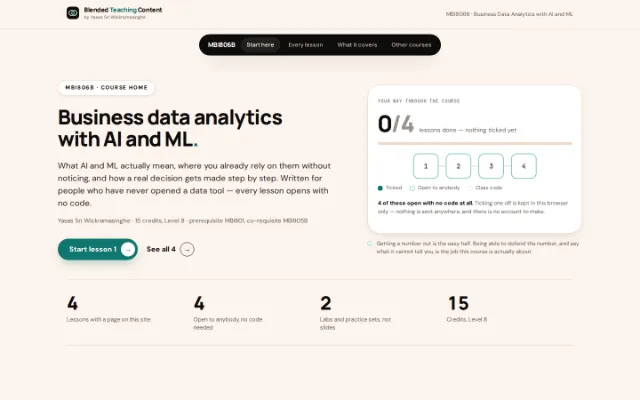
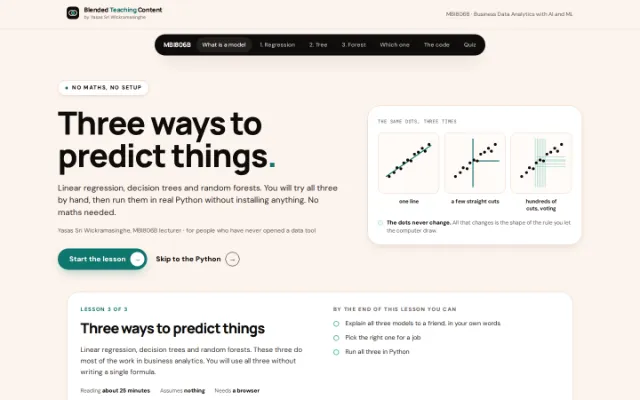
MBI806B 4 lessons

Business Data Analytics with AI and ML

What AI and ML actually mean, where you already rely on them without noticing, and how a real decision gets made step by step.

  • LO1Decide with AI and ML
  • LO2Use industry tools
  • LO3Visualise for an audience
  • LO4Judge it ethically

15 credits, Level 8 · prerequisite MBI801, co-requisite MBI805B

Running on this page

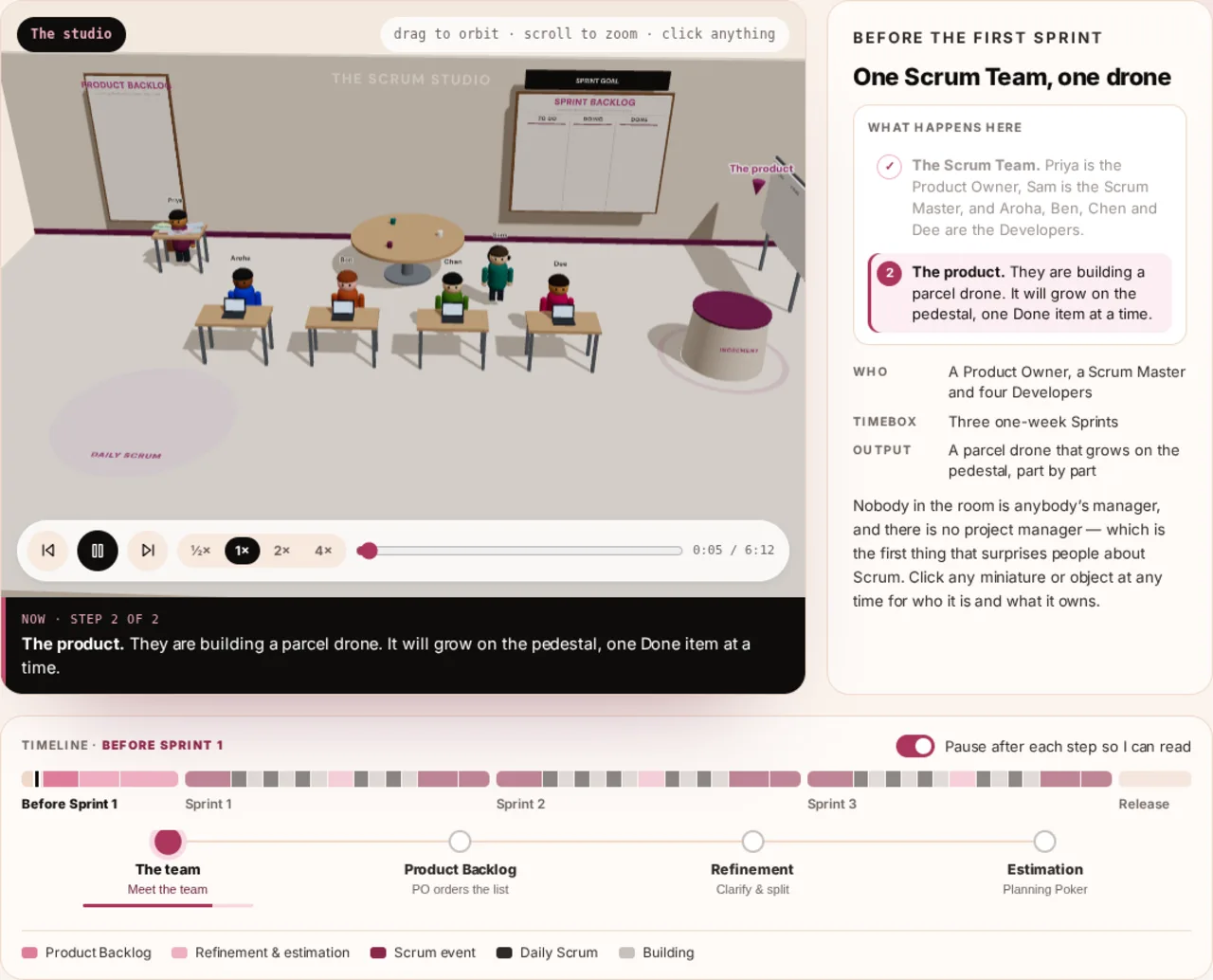
Here's one. Press play.

This is the Scrum studio from MBI804, the real thing rather than a recording. A small team builds a parcel drone over three one-week Sprints. Drag to look around, click on anyone to see what their job is, and it stops after each step so you can read what just happened.

  • 3one-week Sprints
  • 6people on the team
  • 3Dright in the browser
The Scrum studio: a 3D office where a team of six builds a parcel drone

Loading the studio…

From MBI804 Lesson 3. The full lesson, with the reading and a seven-question check at the end, is on the lessons site ↗

How I put a lesson together

You try it first. Then I explain it.

These six habits are behind every lesson, whatever the course. It's pretty much how I teach in the classroom as well.

  1. 01

    Something to do on the first screen

    A lesson starts with a task, not a definition. In the database course you break a hospital's spreadsheet until it contradicts itself. In project management you pin two corners of the triangle and watch the third one move.

    Seen in Introduction to DBMS · What a project is

  2. 02

    Simulations instead of slides

    Some ideas only make sense when you see them move. So you run a sales loop for twelve months and watch the obvious fix backfire, or watch a Scrum team build a drone over three Sprints and pause at each event.

    Seen in Systems thinking · The Scrum studio

  3. 03

    Wrong answers get explained too

    In the quizzes, every wrong option has its own explanation. The answer a student picks usually tells you exactly what they misunderstood, so that's the moment to explain it. Nothing is saved or graded.

    Seen in MBI800 Lesson 1 · MBI804 Lesson 1

  4. 04

    Real companies where I can

    Netflix, Kodak and Fujifilm, NZ Post, Airbnb, Xero and Canva all turn up. When I do make a scenario up, like the SecurePay NZ project in cost management, I build it out properly so the numbers hold together.

    Seen in Threats to strategy · Cost management

  5. 05

    The order matters

    In the database course it's SQL, then diagrams, then mapping, then normalisation. Each lesson leans on the one before, so the list is in the order I teach it, not sorted by topic.

    Seen in the MBI802 course path

  6. 06

    Nothing to install

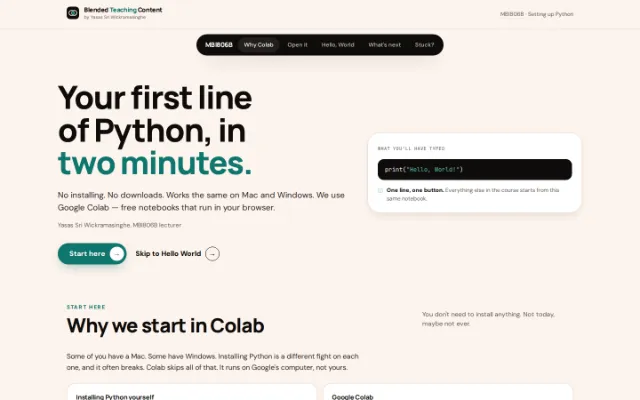
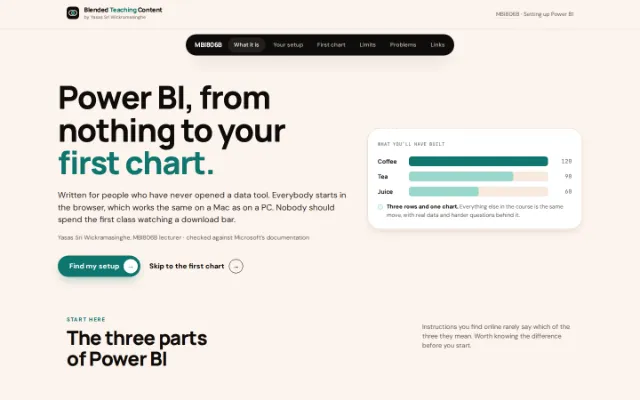
    No login, no downloads. Python runs in Google Colab and Power BI starts in the browser, because I don't want anyone spending their first class watching a progress bar.

    Seen in Setting up Python · Setting up Power BI

All the lessons

Everything, in the order I teach it.

Filter by course or type, or just search. Each card opens the lesson in a new tab.

MBI800

Strategic Information Systems Planning

The course runs from a single system to a whole industry: systems thinking first, then five platforms that rewired their markets, then what it costs when security is an afterthought.

Course home
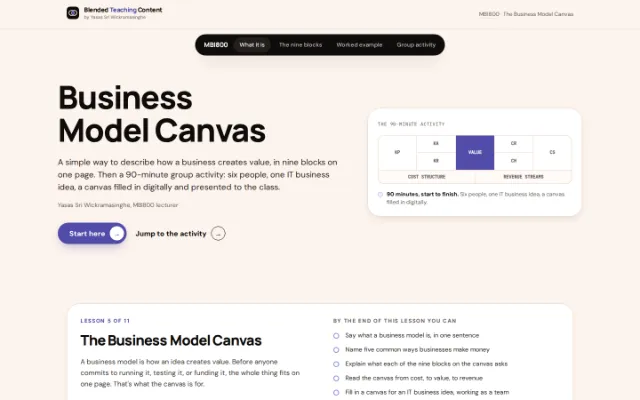
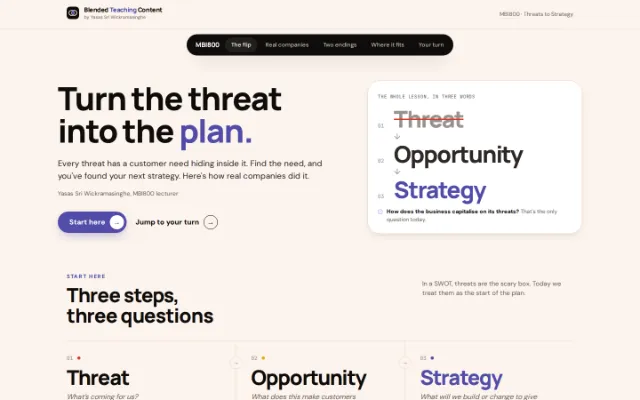
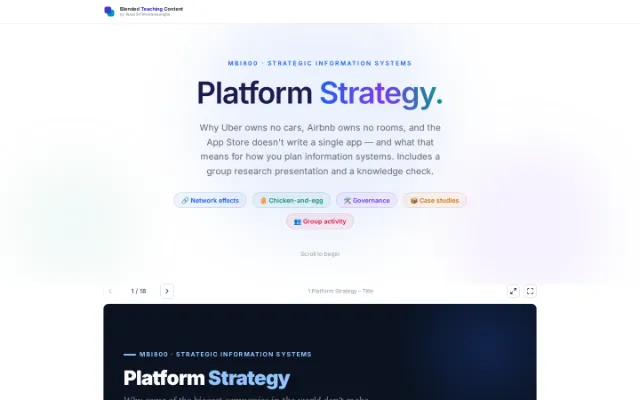
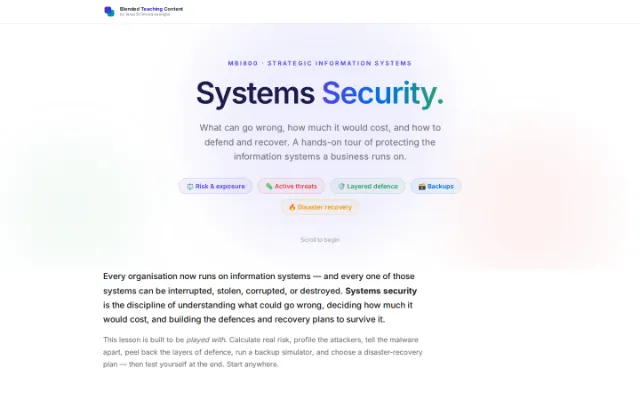
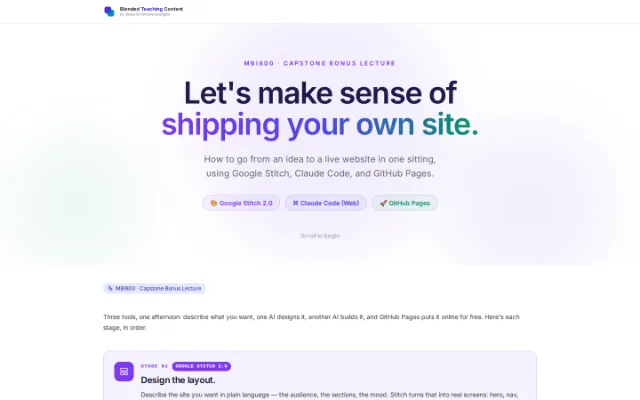
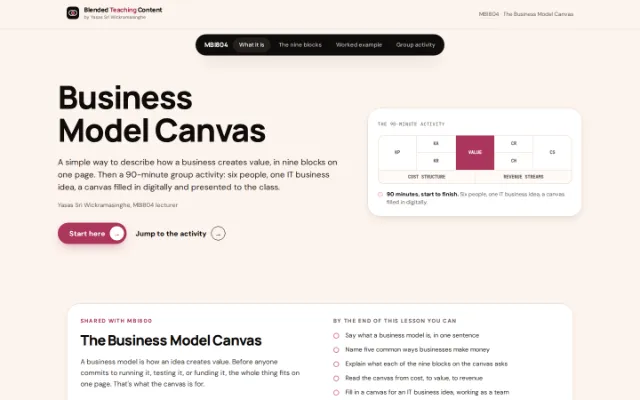
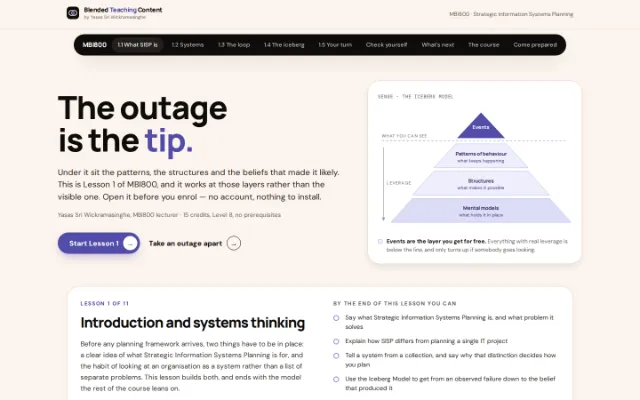
01Lesson Introduction and systems thinking The whole of Lesson 1: what strategic planning actually decides, systems against collections, a sales loop you can run for twelve months to watch the obvious fix rebound, and the Iceberg Model taken down through a real outage. Ends with a knowledge check. Open lesson 02Lesson The Business Model Canvas How a business model works, laid out on one page in nine blocks. Then a 90-minute group activity: six people, one IT business idea, a canvas filled in digitally and presented as a short slide deck. Open lesson 03Lesson Threats to opportunities to strategy How a business capitalises on its threats. Netflix, Apple, Adobe, Microsoft, NZ Post and Google each turned a threat into a strategy, Kodak and Fujifilm took the same threat two ways, then you flip six threats yourself. Open lesson 04Lesson Five stories that changed everything Airbnb, Netflix, Xero, Canva and Alibaba — how each started from one frustration and built a platform that rewired its industry. IS architecture, growth figures and discussion questions for each. Open lesson 05Lesson Platform strategy Why Uber owns no cars and the App Store writes no apps. Network effects, the chicken-and-egg problem, governance and boundary resources, Amazon against GE Predix — then a group research task and a knowledge check. Open lesson 06Lesson Systems security What can go wrong, what it would cost, and how to defend and recover. Calculate real risk exposure, profile the attackers, tell malware apart, run a backup simulator and choose a disaster-recovery plan. Open lesson 07Lesson Immersive realities A walk through AR, VR and mixed reality, with two demos that run in the browser. No headset needed, and no prior graphics knowledge assumed. Open lesson 08Lab Capstone: shipping your own site The final lecture. Design a layout in Google Stitch, turn it into real code with Claude Code, and put it live on GitHub Pages. Includes a prompt generator for your own portfolio. Open lesson 09Pack The written study pack The whole course rewritten as a properly typeset book: eleven chapters, worked examples, practice questions and answer keys. Yours to download and keep. Open lesson
MBI802

Database Management Systems

Each lesson assumes the one before it. SQL before diagrams, diagrams before mapping, mapping before normalisation — that order is the course, not a filing system.

Course home
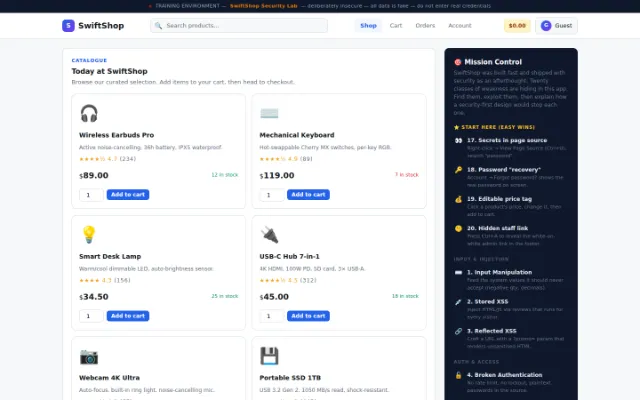
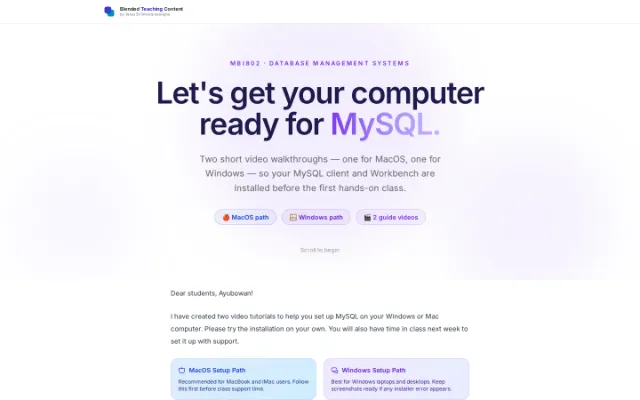
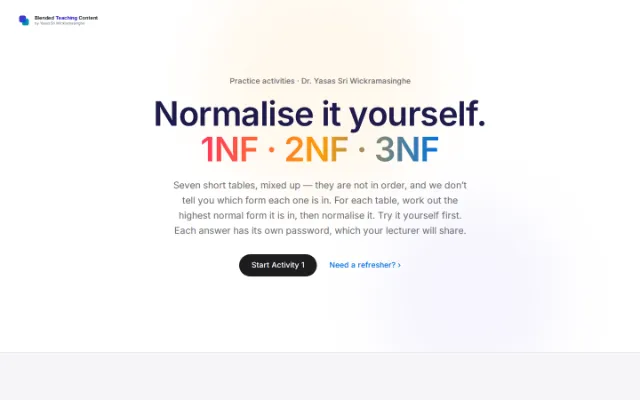
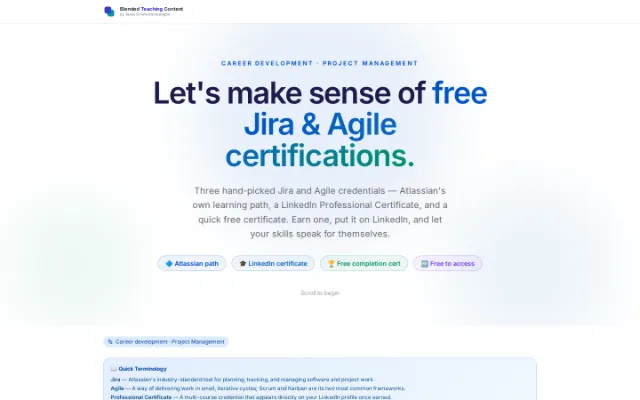
01Lesson Introduction to DBMS Break a hospital's spreadsheet and watch it contradict itself, turn a bare number into information, then read the full eight-lesson outline with a preview of the material. Nothing to install. Open lesson 02Video Setting up MySQL Two short guide videos — one for MacOS, one for Windows — so your MySQL client and Workbench are installed and ready before the first hands-on class. Open lesson 03Lesson Introduction to SQL with MySQL The language databases actually speak. Create a database, build a table, insert real rows, then ask it questions — one interactive slide at a time. Open lesson 04Lesson Advanced database concepts One table, built up step by step: add a column, change a data type, set a primary key and auto-number it, back it up and restore it, then ORDER BY and count it. Finishes with a safe look at SQL injection. Open lesson 05Lesson Client, server and databases How a website actually works, for absolute beginners. Sort jobs between the two computers, then follow one search all the way to the database and back — watching the server run the SQL as it goes. Ends in a safe attack lab. Open lesson 06Lesson ER diagrams Sketch the world before you build the tables. Entities, attributes and relationships in Chen's notation, and how to read cardinality at a glance. Open lesson 07Practice ER diagrams in practice Model five real systems — a library, a university, a hospital, an online store and a hotel — then check your diagram against a worked answer. Open lesson 08Lesson Advanced ER concepts Real data is messier than the textbook. Weak entities, identifying relationships, and multivalued or derived attributes, with two exercises to test yourself. Open lesson 09Lesson Attributes and participation The details that decide whether a model is right or wrong. Break attributes into their parts, then read total against partial participation through guided activities. Open lesson 10Lesson ER to relational mapping Turn entity-relationship diagrams into real relational tables — entities, relationships, keys, and every tricky case in between. Open lesson 11Lesson Database normalisation From messy tables to clean ones. Spot the anomalies, then split a table step by step from 1NF all the way to 3NF. Open lesson 12Practice Normalisation activities Seven short tables to practise on, mixed up and with no hints. Work out what normal form each is in and normalise it. The answers sit behind a password so you try it first. Open lesson 13Video Normalisation on video Prefer to watch? A short walkthrough series — why we normalise, functional dependencies, and First Normal Form — each as a clip you can play any time. Open lesson 14Video UPDATE and DELETE Change and remove rows with confidence. Short scrollable reels that show how to edit data without breaking everything around it. Open lesson 15Lab SwiftShop security lab A deliberately insecure shop with twenty hidden vulnerabilities, from editable price tags and secrets in the page source to XSS, privilege escalation and business-logic flaws. Find them, exploit them, then explain the fix. Open lesson 16Reference Free SQL certifications Nine genuinely free credentials — Oracle badges, IBM digital badges, HackerRank exams, Cisco certs and more. No credit card for any of them. Open lesson 17Pack The written study pack The whole course rewritten as a properly typeset book: eight chapters, worked examples, practice questions and answer keys. Yours to download and keep. Open lesson
MBI804

IT Project Management

The course keeps returning to one question: which of the three constraints are you willing to move? Every estimate, every risk and every conflict on this page is another way of asking it.

Course home
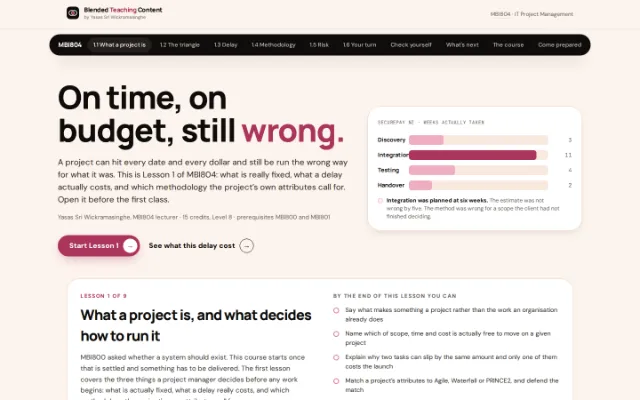
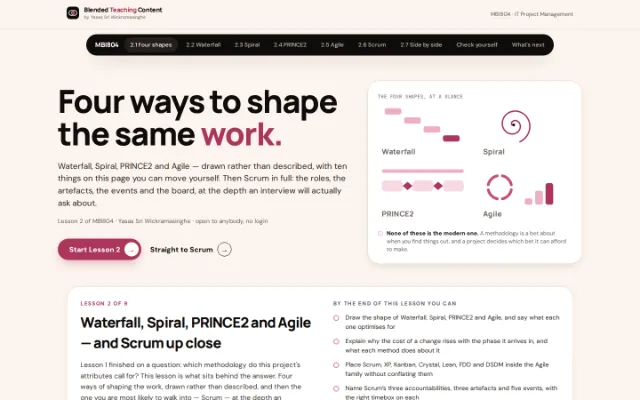
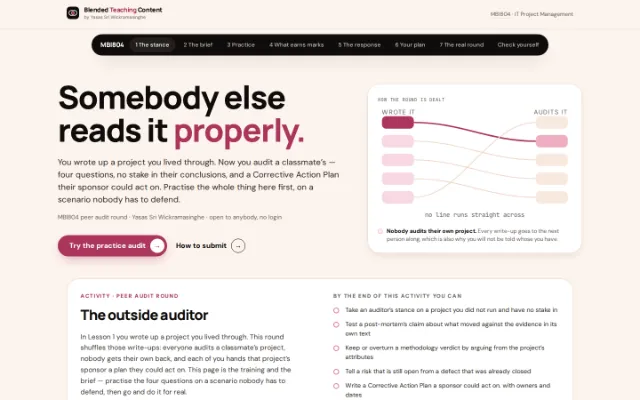
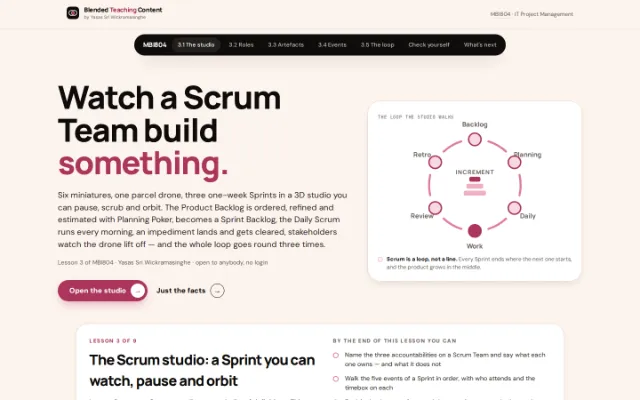
01Lesson What a project is, and what decides how to run it The whole of Lesson 1: pin two corners of the constraint triangle and watch the third move, slide a delay along a real schedule to find which tasks the launch date cares about, choose between Agile, Waterfall and PRINCE2 across four project shapes, then price a risk on the grid. Open lesson 02Lesson The Business Model Canvas How a business model works, laid out on one page in nine blocks. Then a 90-minute group activity: six people, one IT business idea, a canvas filled in digitally and presented as a short slide deck. Shared with MBI800. Open lesson 03Lesson Waterfall, Spiral, PRINCE2 and Agile — and Scrum up close Lesson 2, and the one the 60% case study leans on. Four lifecycles drawn rather than described, a change dragged along the cost-of-change curve, Boehm’s spiral walked loop by loop, PRINCE2’s seven principles, themes and processes opened one at a time, then the whole Agile family — and Scrum in full: a clickable framework diagram, twelve “whose job is this?” situations, timeboxes that scale with the Sprint, and a board with a live burndown. Open lesson 04Lesson The Scrum studio: a Sprint you can watch, pause and orbit Lesson 3. Six 3D miniatures build a parcel drone through three one-week Sprints while a caption says what is happening and a timeline marks every milestone: the Product Backlog ordered on the wall, refined and estimated with Planning Poker, Sprint Planning pulling cards into the Sprint Backlog, a fifteen-minute Daily Scrum every morning, an impediment landing and being cleared, stakeholders watching the drone lift off at the Review, one improvement from each Retrospective. It pauses after each step so you can read, then a seven-question check. Open lesson 05Practice The outside auditor: peer audit round The class swaps post-mortems — you audit a project you did not run, and nobody gets their own back. Practise the four audit questions on a fictional scenario whose author is confident and wrong about all of them, sort eight sentences into restating, asserting and auditing, choose a risk response where mitigating is the wrong answer, then build the one-page Corrective Action Plan and export it. Open lesson
06LessonOffline for now Project cost management Plan, estimate, budget — and avoid the traps that sink most IT projects. Seven interactive sections around the SecurePay NZ scenario: PERT calculator, budget builder, live S-curve and a closing challenge. Not available right now
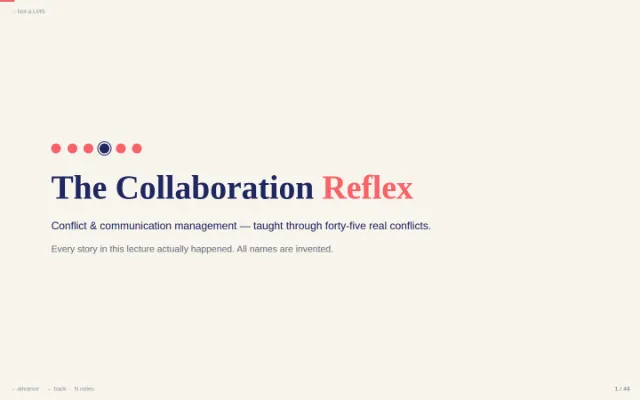
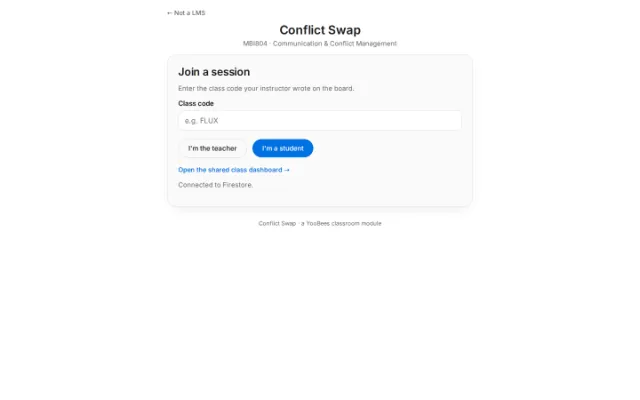
07Lesson The collaboration reflex Conflict and communication management taught through forty-five real, anonymised classroom conflicts: six full stories, four frameworks, and the one reflex experienced professionals reach for even when it is the wrong answer. Open lesson 08Practice Conflict swap Write a real conflict you have lived through, anonymously. The class shuffles everyone's stories so you analyse someone else's — root cause, the mode that was used, and the mode that should have been. A class code from me, no login. Open lesson 09Reference Free Jira and Agile certifications Three hand-picked credentials: Atlassian's own Jira learning path, a LinkedIn Agile Professional Certificate, and a quick free completion cert. Open lesson
MBI806B

Business Data Analytics with AI and ML

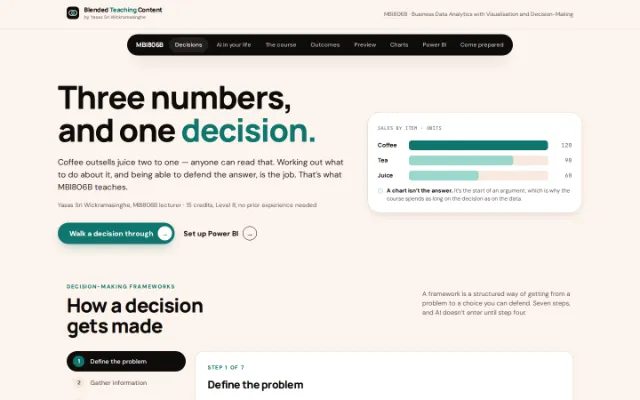
Getting a number out is the easy half. Being able to defend the number, and say what it cannot tell you, is the job this course is actually about.

Course home
All four

Shared across every course

These two aren't tied to one course, so every class gets them.

This list was last updated from the lessons site on 27 September 2026. The lessons themselves live on my lessons site.

For my students

The course notes, as a proper book.

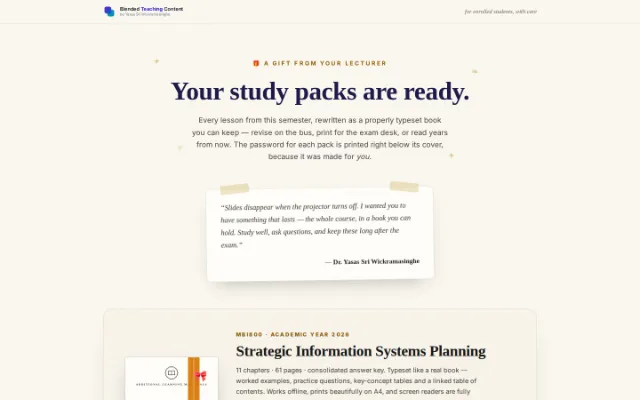
If you're enrolled in MBI800 or MBI802, you can also download the whole course as a typeset study pack, with worked examples, practice questions and the answers. It's yours to keep.

See the study packs ↗
Say hello

Curious how these get made?

I'm always happy to talk about it, whether you teach, run a programme, or you're thinking about studying with me. Send me a message and I'll get back to you.