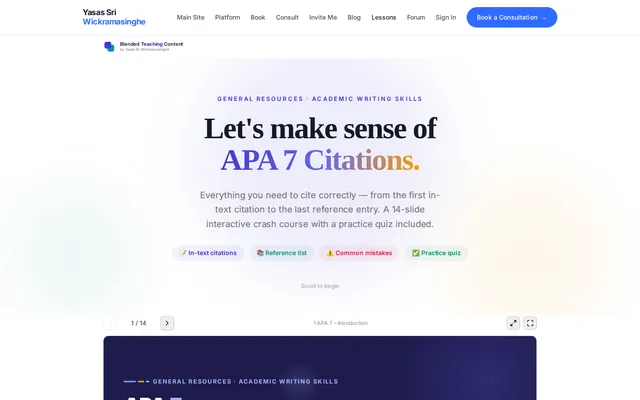
This is the written version of an interactive, slide-by-slide deck. The live diagrams, worked examples and practice quiz are in the interactive deck.
In this lesson
- In-text citations
- Reference list
- Common mistakes
- Practice quiz
The Crash Course
Everything you need to cite correctly — from the first in-text citation to the last reference entry. Built for your assignments. No textbooks required.
14 Slides Interactive Examples Reference Templates Practice Quiz Included
After the SlidesTest Your APA 7 Knowledge
8 questions · Click through each question · Instant feedback · No data stored
Knowledge CheckAPA 7 Citation Quiz
In APA 7, how do you cite a source with 3 or more authors for the very first time?
Using someone's idea without credit is plagiarism — even accidentally. A citation is your proof you know the difference between your thinking and someone else's. No citation = no defence.
Academic integrity shield
"Immersion increases presence" — opinion. "Immersion increases presence (Slater, 2009)" — claim backed by a decade of VR research. Same sentence. Completely different weight.
They Invite Conversation
Academic writing isn't a monologue — it's you positioning your ideas within an ongoing scholarly debate. Citations show you've been listening, and you know who said what first.
Join the scholarly conversation
The "says who?" test: Imagine your examiner asking "says who?" after every claim you make. Citations are your answer. Without them, you're just asserting things into the void.
Same Sentence. Different Weight.
"Scientists say coffee makes you smarter."
What happens:
- ⚠️ Examiner asks: "Which scientists? Where? When?"
- ⚠️ Sounds like an unverified social media claim
- ⚠️ Could be penalised for unsupported assertion
- ⚠️ If it's someone else's idea — this is plagiarism
Your friend (the examiner) is far less forgiving.
"Caffeine consumption has been associated with enhanced cognitive performance in controlled studies (Smith et al., 2021, p. 14)."
- ✅ Reader can verify the source independently
- ✅ Shows engagement with academic literature
- ✅ Demonstrates scholarly credibility
- ✅ You are protected against plagiarism accusation
Same idea. Now it's a verifiable academic claim.
When TO Cite — click each card to reveal why
Facts, statistics & findings
Any fact that came from a specific study, dataset, or report. Even if widely known within your field, if it has a source — cite it. E.g. "87% of Agile teams use Scrum" needs the State of Agile report.
Someone else's argument, model, or framework. Even if you're paraphrasing it — you're using their intellectual work. Presence theory (Witmer & Singer), Agile Manifesto, TAM model — all need citations.
Especially contested or field-specific definitions. "Presence is defined as..." is someone's definition — whose? Even for widely agreed terms, citing the first/key theorist shows depth and awareness.
Obviously. Any word-for-word text from a source requires quote marks + author + year + page number. Even a single distinctive phrase taken verbatim needs a page-level citation.
Surveys, questionnaires, measurement scales, or research instruments designed by others. The Presence Questionnaire, SUS, TAM scales — all have original authors who must be credited.
Yes — even your own previously published work. Reusing your own ideas without citing yourself is called self-plagiarism. If you published it elsewhere, treat it like any other source.
Over-citing clutters your writing and actually signals low confidence — it looks like you can't tell what's common knowledge and what isn't.
"The internet is widely used" — no citation needed. Any reasonably educated person already knows this.
Mathematical or logical facts
"The sample had 24 participants split into 4 groups of 6" — this is your own arithmetic. No source needed.
Your own original analysis
Your interpretation, argument, and conclusions are your contribution. Don't undercut it by citing someone else — own it.
Your own firsthand observations
Things you observed, measured, or found in your own study. "Participants reported feeling dizzy" — this is your data.
Would a reasonable person in your field consider this general knowledge? If yes → no citation. If there's any doubt → cite it. When in doubt, cite.
One In-Text → One Entry. Always.
Every in-text citation has exactly one matching entry in the reference list.
Every reference list entry is cited somewhere in the text. No orphans. No extras.
A reference list entry with no matching in-text citation. You read it, but never cited it. Remove it — APA is not a bibliography.
An in-text citation (Brown, 2021) with no matching reference list entry. Always fatal — the reader can't find the source.
(Slater, 2009, p. 12) Smith and Jones (2021)
Slater, M. (2009). Place illusion... Phil. Trans. R. Soc. B, 364...
Two Flavours of In-Text Citation
Citation lives in brackets at the end
The idea matters more than the person who said it. You're reporting a finding, not engaging with a specific author's argument.
(Author, Year) or (Author, Year, p. N)Author is part of your sentence, year follows in brackets
You're specifically engaging with who said something. You're introducing their argument, critiquing it, or contrasting it with another author's view.
Author (Year) verb... or Author and Author (Year)...The Author–Year Cheat Sheet
| Situation | Format | Example |
|---|---|---|
| 1 author | (Author, Year) | (Slater, 2009) |
| 2 authors | (Author & Author, Year) | (Slater & Sanchez-Vives, 2016) |
| ⭐ 3+ authors APA 7 change! | First author + et al., from first use | (Cummings et al., 2020) |
| Organisation (first mention) | (Full Name [ABBR], Year) | (World Health Organization [WHO], 2022) |
| Organisation (subsequent) | (Abbreviation, Year) | (WHO, 2022) |
| No date available | (Author, n.d.) | (Smith, n.d.) |
| Same author, same year | (Author, Yeara, Yearb) | (Brown, 2021a, 2021b) |
| Multiple sources together | (Auth1 & Auth2, Year; Auth3, Year) | (Milgram & Kishino, 1994; Witmer & Singer, 1998) |
| Direct quote | (Author, Year, p. N) | (Witmer & Singer, 1998, p. 225) |
⭐ APA 7 key change: Three or more authors → use et al. from the very FIRST citation. APA 6 made you write all names up to 5 authors first. That rule is gone.
Direct Quotation · Part 1Short Quotes: Under 40 Words
"Presence is defined as the subjective experience of being in one place or environment, even when one is physically situated in another " (Witmer & Singer, 1998, p. 225).
- Quotation marks around the exact words
- Inline — do not break to a new paragraph
- Page number is required (p. 225)
- Citation at end, before the full stop
- Missing page number on a direct quote
- Using a block quote format for under 40 words
- Altering words inside the quote without [brackets]
- Overusing quotes — paraphrase instead
Honest advice: Your examiner wants to see you synthesise ideas, not collect them. Use direct quotes only when the exact wording matters — definitions, key terms, pivotal statements. A paraphrase that cites correctly shows more skill.
Direct Quotation · Part 2
The concept of presence is not simply about visual fidelity but rather about the degree to which the virtual environment responds to the actions of the participant. A high-fidelity environment that does not react to user input will produce lower presence than a lower-fidelity, richly interactive one. (p. 431)
The author + year introduce the quote (narrative style), then the page number appears in brackets after the final full stop — not before it. This is reversed from short quotes.
- New paragraph for the quote
- Indent the entire block (0.5 inch / ~1.27 cm)
- No quotation marks
- Page number in brackets after the final stop
- Introduce with a colon or "X argued:" or "According to X (Year):"
Short vs Block at a glance
| Under 40 words | Inline, quotation marks, citation before the stop |
| 40+ words | Indented block, no quotes, citation after the stop |
Every Reference Has Four Parts
Last name, Initials. For multiple: Last, I., & Last, I.
Publication year in brackets. Use n.d. if no date.
Title in sentence case. Book/journal titles in italics.
Publisher, journal, DOI, or URL. Always prefer DOI.
Slater, M. (2009). Place illusion and plausibility can lead to realistic behaviour in immersive virtual environments. Philosophical Transactions of the Royal Society B, 364(1535), 3549–3557. https://doi.org/10.1098/rstb.2009.0138📄 WHAT (title + journal)
Reference Templates · Part 1
- → Article title: sentence case, no italics
- → Journal name: Title Case, italicised
- → Always use https://doi.org/ prefix
Sherman, W. R., & Craig, A. B. (2018). Understanding virtual reality: Interface, application, and design (2nd ed.). Morgan Kaufmann.- → Book title: italicised, sentence case
- → Edition in brackets if not first ed.
- → Publisher name only (no location in APA 7)
University of Canterbury. (2023, August 1). HIT Lab NZ research overview. https://www.hitlabnz.org- → Include the specific date if shown on page
- → Page title in italics, sentence case
- → No "Retrieved from" in APA 7
Reference Templates · Part 2
McMahan, R. P. (2017). Exploring the effects of higher-fidelity display and interaction. In F. R. Nack & A. S. Gordon (Eds.), Interactive storytelling (pp. 59–68). Springer.- → Chapter author is first; editors after "In"
- → Only the book title is italicised
- → Page range in (pp. x–x) format
Bowman, D. A., & Hodges, L. F. (1997). An evaluation of techniques for grabbing and manipulating remote objects in immersive virtual environments. In Proceedings of the 1997 Symposium on Interactive 3D Graphics (pp. 35–38). ACM. https://doi.org/10.1145/253284.253301- → Proceedings title italicised (like a book)
- → Include publisher (ACM, IEEE, Springer…)
- → DOI strongly preferred over URL
Unity Technologies. (2023). Unity (Version 2022.3 LTS) [Computer software]. https://unity.com- → Software name italicised
- → Version number in regular brackets
- → [Computer software] descriptor after title
Based on: American Psychological Association. (2020). Publication manual of the American Psychological Association (7th ed.). https://doi.org/10.1037/0000165-000
Common Errors · Click each card to reveal the fix
Confusing et al. when names clash
Two papers share first authors + year. APA says write enough names to distinguish them — then et al. Don't assume the first name is enough.
These footnote shorthand terms belong to Chicago/Oxford style. APA never uses them. Ever. Just repeat the full author–year citation each time.
Citing only the abstract
If you only read the abstract, you only read part of the paper. Don't cite findings from sections you haven't read. Read the paper. Then cite it.
Padding the reference list
APA reference list = only sources cited in the text. Nothing extra. A bibliography includes background reading — APA doesn't. Remove anything you didn't cite.
Missing DOIs / using raw URLs
Always search for a DOI before using a plain URL. DOIs are permanent — URLs rot. Always prefix: https://doi.org/ not dx.doi.org or just the number.
📚 Reference: American Psychological Association. (2020). Publication manual of the APA (7th ed.) · Scroll to the quiz below to test your knowledge