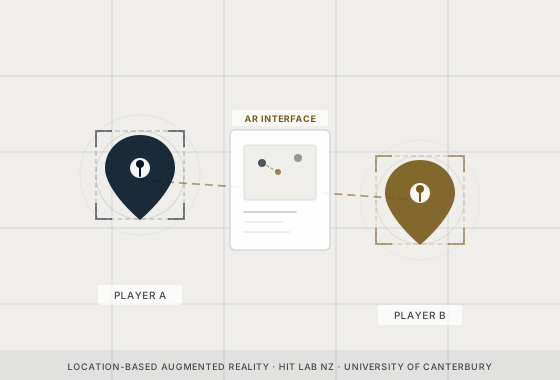
My research designs, builds, and evaluates location-based augmented reality games that let physically separated players share a single augmented space. Through a research-through-design approach, I study how AR can move beyond decoration to become a core mechanic — reframing place itself as a shared, interactive canvas across distance.
“How can augmented reality make meaningful use of the real world to facilitate synchronous remote multiplayer gameplay?”
Most location-based AR games treat AR as an optional visual layer — players can often switch it off without changing the game. My doctoral research asks the opposite: what happens when AR becomes the mechanism that binds remote places and players together? I answer this across three empirical user studies, organised around three research questions on representing remote space, spatial decision-making, and interactive AR mechanics.
Supervised by Prof. Stephan Lukosch, A. Prof. Heide Lukosch, and James Everett, this thesis uses an iterative research-through-design method — cycles of design, development, and evaluation — to investigate how AR can represent remote spaces, support spatial decision-making, and drive engagement through core game mechanics. The work spans five peer-reviewed publications (Articles I–V) and contributes theoretically, empirically, methodologically, and practically to the design of remote multiplayer AR games.
Each study sharpens the next, building from how a remote place should look, to how players behave inside it, to the mechanics that make distributed play meaningful.
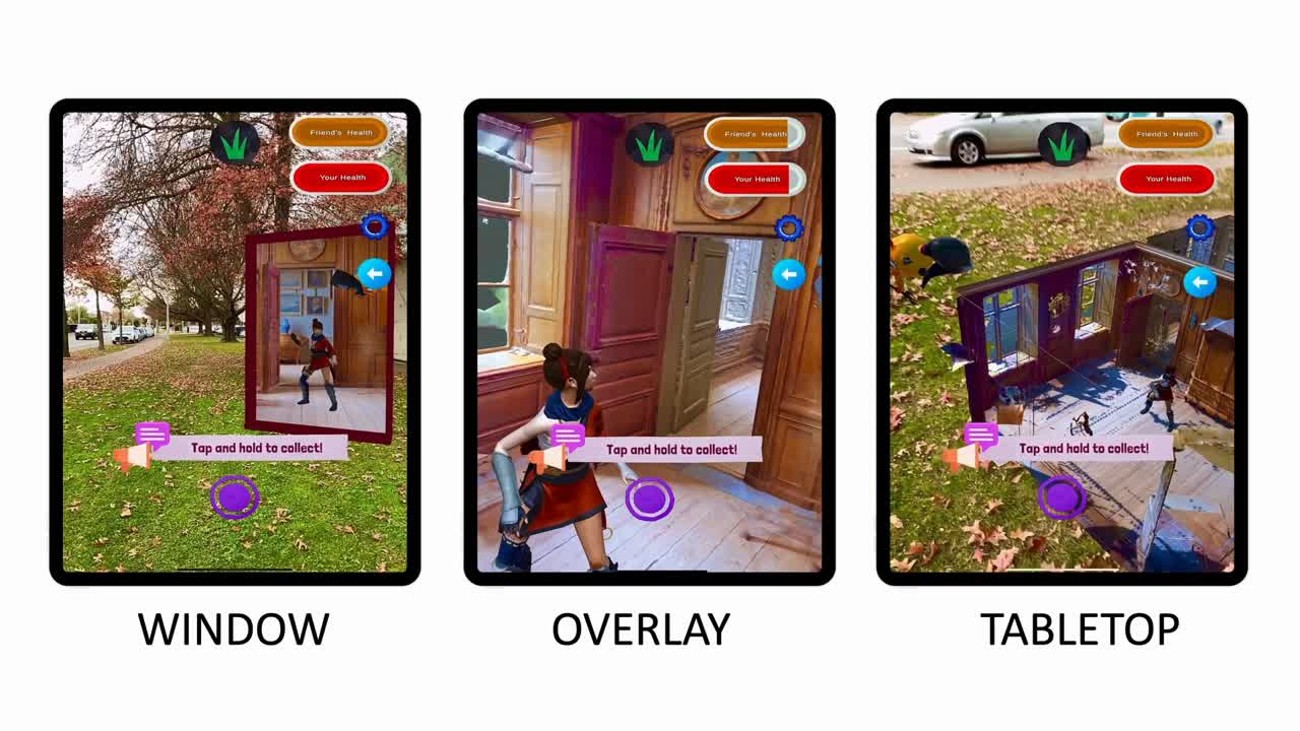
Compared three AR techniques — Overlay, Window, and Tabletop — for portraying a remote location. Overlay produced the strongest sense of “being there” and self-location; Window felt like the remote place extending into your own; Tabletop offered a detached strategic overview.
A remote multiplayer AR hide-and-seek game compared against co-located play. AR shifted spatial strategies — players exploited mid-air and vertical space — and a lightweight frustum cue strengthened social connection without avatars or video.
Introduced interactive core AR mechanics — real-time object manipulation, particle-effect feedback, and time pressure. These deepened strategic search behaviour and engagement when paired with clear feedback and well-calibrated constraints.
Synthesised from all three studies — practical guidance for designing AR games that connect remote players and places.
Prioritise real-world-scale Overlay views for spatial presence, use Window “portals” as an intuitive interface for sharing resources between locations, and ground it all in high-fidelity 3D scans of the remote environment.
Visualise the remote player's viewpoint in real time and add voice. Minimal orientation cues (a frustum avatar) coordinated players as effectively as far heavier embodiment — connection without high-fidelity avatars.
Embed AR in the gameplay loop rather than as decoration: multiple remotely anchored objects, real-time manipulation, and carefully calibrated time pressure that stretches players without overwhelming them.
Subtle feedback — like particle trails marking object swaps — supports orientation while preserving discovery. Support onboarding to reduce early disorientation, and design for player safety during physical movement.
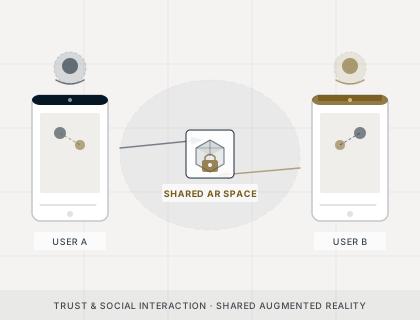
Investigating how design choices shape trust when users exchange virtual items in shared AR environments. A 36-participant study presented at the ACM Symposium on Spatial User Interaction 2024.
ACM DL Paper ↗Co-founded an AR/VR startup under the MIT Global Startup Labs programme. Built mobile AR apps and VR web applications in Sri Lanka — Microsoft Imagine Cup Runner-Up 2015.
Wickramasinghe, Y.S., Lukosch, H.K., Everett, J., & Lukosch, S. — Multimodal Technologies and Interaction, 9(8), 79. MDPI.
Wickramasinghe, Y.S., Lukosch, H., Everett, J., & Lukosch, S. — 37th Australian Conference on Human-Computer Interaction (OzCHI '25). ACM.
Wickramasinghe, Y.S., Lukosch, H., Everett, J., & Lukosch, S. — 2025 IEEE Conference on Virtual Reality and 3D User Interfaces (IEEE VR '25). IEEE.
Wickramasinghe, Y.S., Lukosch, H.K., Everett, J., & Lukosch, S. — Entertainment Computing, 53, 100932. Elsevier.
Wickramasinghe, W.A.U.Y.S. — PhD Thesis. University of Canterbury, Christchurch, New Zealand.
Ritter, M., Liew, K., Wickramasinghe, Y.S., & Lukosch, S. — Proceedings of the 2024 ACM Symposium on Spatial User Interaction (SUI '24). ACM.
Ritter, M., Lukosch, S., Liew, K., & Wickramasinghe, Y. — HIT Lab NZ, University of Canterbury.
Wickramasinghe, Y.S., Lukosch, S., & Lukosch, H. — 54th Conference of the International Simulation and Gaming Association (ISAGA 2023), pp. 204–214.
Wickramasinghe, W.A.U.Y.S., De Saram, P.S.R.S., Liyanage, C.P., & Rangika, L.N.R. — Journal of Software Engineering & Software Testing, 6(3), 34–75. ManTech Publications.
Inparajah, J., & Wickramasinghe, W. — 15th International Research Conference, p. 36.
Wickramasinghe, W., De Saram, P., Liyanage, C.P., Rangika, L.N.R., et al. — 2017 IEEE 3rd International Conference on Engineering Technologies and Social Sciences (ICETSS). IEEE.
Wickramasinghe, W., & Gunasekara, E.H.D.A. — Research Symposium of the Information Technology Research Unit (ITRU 2015). University of Moratuwa, Sri Lanka.
Co-authoring with researchers at HIT Lab NZ, University of Moratuwa, and Niantic Aotearoa.
Full citation record and publication history.
LabThe location-based AR games research project page.
ThesisFull dissertation at the University of Canterbury.
ProfileInstitutional research profile at Yoobee Colleges.