I design experiential, technology-forward classrooms — and build the platforms that power them. My Master's programme teaching is inseparable from the state-of-the-art learning management system I built to bring attendance, live coding, competitive SQL, and AI-assisted reasoning into every session.
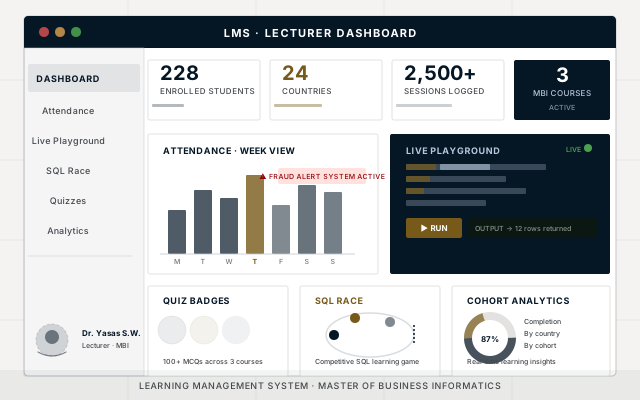
It's a state-of-the-art learning management system: a full-stack web application I designed and built from scratch for the Master of Business Informatics (MBI) courses I teach. It replaces static slide decks and paper registers with a live, interactive, data-driven classroom experience.
Every feature was shaped by a real classroom problem — from fraudulent attendance submissions caught by three detection algorithms, to students competing on SQL queries in real time.
OPEN-SOURCE · GITHUB.COM/URESHAN2011
Students check in with a single tap. Three detection algorithms run in real time to flag dishonest submissions: shared-IP clustering (multiple students on one device), GPS outlier detection (coordinates >500 m from campus), and a rapid-submission window (check-ins within 30 s of session open).
An in-browser code execution environment embedded directly in lectures. Students write and run SQL, Python snippets, and pseudocode without leaving the platform — and I can see their output live.
Students race around a virtual track by solving SQL challenges in sequence — SELECT → WHERE → JOIN → GROUP BY → ORDER BY → HAVING. A live leaderboard drives friendly competition and keeps engagement high across 228 students.
Over 100 MCQ questions across all three MBI courses. Students earn badge tiers as they progress, with instant feedback and explanations. Results feed directly into the lecturer analytics dashboard.
A daily collaborative challenge pairs students across cohorts to solve a shared problem together. Designed to build cross-cultural communication skills in an international classroom spanning 24 countries.
A lecturer-only dashboard surfaces attendance trends, quiz completion rates, country-level engagement, and fraud alert history — giving me a full picture of each cohort without manual data wrangling.
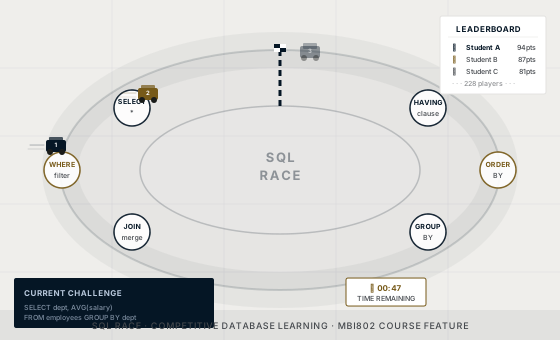
SQL Race transforms database exercises into a live, multiplayer competition. Each checkpoint on the track corresponds to a core SQL clause. Students only advance by writing a correct query — keeping the learning rigorous while the format keeps energy high.
It was born out of a simple observation: students who were bored by textbook drills became intensely focused the moment there was a leaderboard.
Ten of the decks I use in class also have a copy on this site, each with a written version next to it. For the full set across all four courses, go to the lessons page.
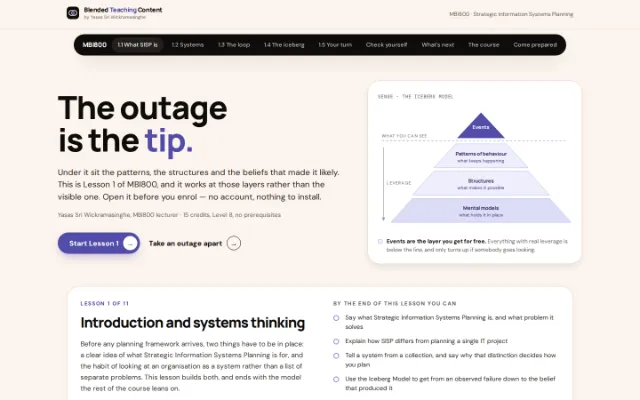
Covers the strategic role of information systems in organisations — from IS alignment and SISP (Strategic Information Systems Planning) to digital transformation frameworks and Porter's competitive models.
✦ PLATFORM FEATURE
SISP Prompt Lab — an AI-assisted tool embedded in the LMS that walks students through strategic IS planning exercises using guided prompts and real case data.
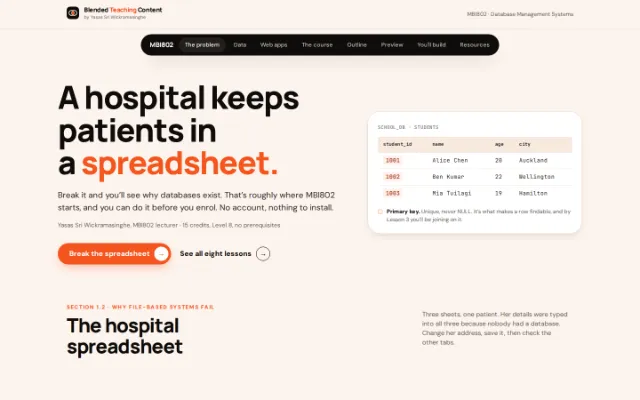
A hands-on deep-dive into relational database design, SQL from basics to advanced joins and stored procedures, ER diagram methodology, normalisation theory, and an introduction to NoSQL paradigms.
✦ PLATFORM FEATURES
SQL Race — competitive live query challenges. Live Playground — in-browser SQL execution environment for practice and demonstrations.
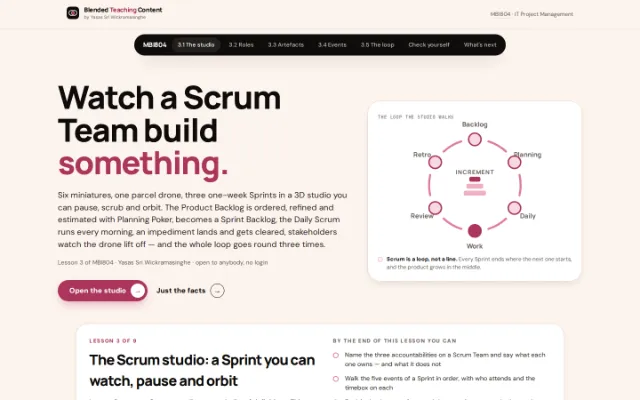
Covers the full project lifecycle — initiation, planning, execution, monitoring, and closure — with a strong practical emphasis on Agile methodologies, Scrum ceremonies, stakeholder management, and risk frameworks.
✦ PLATFORM FEATURE
Case Study Labs — students manage a simulated IT project via the LMS, tracking sprints, updating risk registers, and submitting deliverables with structured peer review.
What AI and machine learning mean for business decisions, taught for people who have never opened a data tool. We cover linear regression, decision trees and random forests without the maths, write Python in the browser, and build a first chart in Power BI.
✦ NO INSTALL
Colab & Power BI in the browser. Python runs in Google Colab and Power BI starts on the web, so it works the same on a Mac or a PC.
Considering applying? Read my guide to studying a master's in New Zealand →
My approach to education is grounded in experiential and constructivist learning — I believe students learn best by building, failing, iterating, and reflecting. Every feature in the LMS was designed around this principle: the Live Playground lowers the barrier to trying, SQL Race makes failure feel like just one more lap, and badge tiers reward persistence over perfection.
I prioritise purpose-driven education: helping students not just acquire technical skills, but develop the vision and initiative to use them meaningfully. In a classroom spanning 24 countries, that also means building cultural fluency and collaborative communication into every assignment — not just technical competence.
"If we can change the way we see the world, we can change the world we see."
Before New Zealand, I spent years in Sri Lankan lecture halls — as a Lecturer at the University of Moratuwa and a visiting lecturer at NSBM, SLIIT and ITUM. I still teach there today, online.
At the Faculty of Information Technology I taught undergraduate modules in object-oriented programming, multimedia and web technologies, computer architecture and enterprise software, databases and human-computer interaction — and supervised final-year and postgraduate research.
As a visiting lecturer I took modules and guest lectures at NSBM Green University, SLIIT and the Institute of Technology, University of Moratuwa (ITUM) — at SLIIT, across database management systems, human-computer interaction, project management and enterprise application development.
I was Platform Lead for the Software Engineering strand of the University of Moratuwa's open learning platform, scaling it to more than 150,000 registered learners — many of them far from any university campus.
Today I teach A/L ICT to Grade 12 and 13 students through ICT Campus, the online classroom I founded — live, in Sinhala and English medium, on the NIE syllabus. Its second programme, Campus Ready, prepares students for the computer and research skills university will expect of them.
My teacher profile on ICT Campus ↗Open to anyone, no account needed.
For the long wait between the exam and the first lecture.
Workshops on AR application development.
Prompting for Security: LLM Code Generation in Angular.
Trust and trustworthiness while exchanging virtual items in shared augmented reality. doi.org/10.26021/15296 ↗
Reimagining Medical Education with VR in Emerging Medical Disciplines.
The Master of Business Informatics (MBI) — specifically MBI800 Business Information Systems, MBI802 Database Management Systems, MBI804 IT Project Management, across the Auckland and Christchurch campuses — and MBI806B Business Data Analytics with AI and ML. The interactive lessons for all four are free to open on the lessons page.
No. This page is Dr. Yasas Sri Wickramasinghe's own account of the courses he teaches, not an official page of the college. For admissions, fees or enrolment, please contact the college directly.
See his guide for prospective students for programme facts, his teaching approach, and a free consultation link.
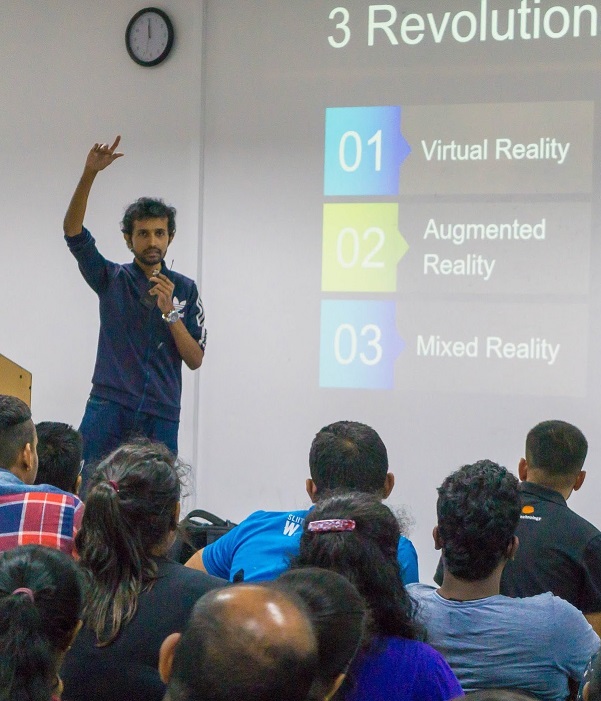
"The classroom is not a place where knowledge is delivered — it's a space where thinking is provoked."Dr. Yasas Sri Wickramasinghe · Lecturer, Master of Business Informatics