This is the written version of Platform strategy, taken from the lesson itself. The simulations, drag-and-drop activities and quizzes only work in the interactive lesson.
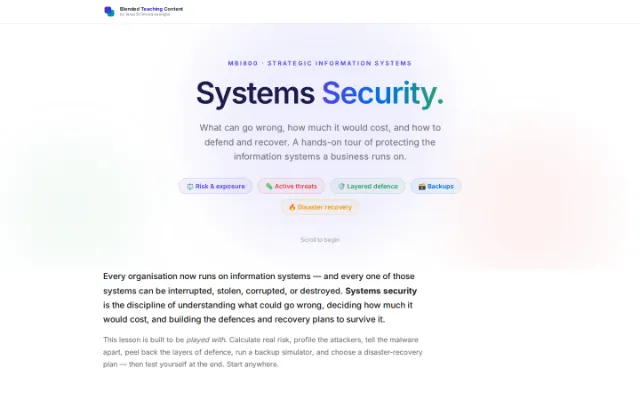
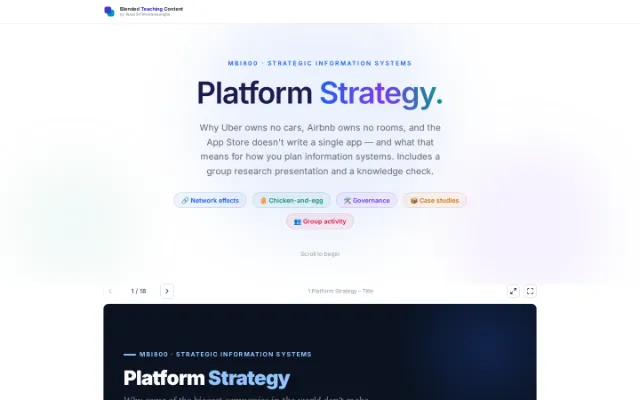
Why Uber owns no cars, Airbnb owns no rooms, and the App Store doesn't write a single app — and what that means for how you plan information systems. Includes a group research presentation and a knowledge check.
🔗 Network effects 🥚 Chicken-and-egg 🛠️ Governance 📦 Case studies 👥 Group activity
Why some of the biggest companies in the world don't make anything at all
Uber owns no cars. Airbnb owns no rooms. The App Store doesn't write a single app. This session is about how that works — and what it means for how you plan information systems.
18 Slides Network Effects Case Studies 40-Min Group Activity Knowledge Check
In-Class Activity · Group of 4–6 · 40 MinutesFind a Platform. Present It.
5 min form groups · 25 min research online and build slides · 10 min present
Group Activity · 4–6 Members · 40 Minutes
Pick any real platform, research it online, and prepare a short presentation for the class.
- Timing (40 minutes total)
- Form groups of 4–6, pick a platform 5 min
- Research online, build simple slides 25 min
- Present to the class 10 min
Stuck for an idea?
Click shuffle for a suggestion — or pick your own
Any real platform works. Use it, or something completely different — your choice.
Your presentation should cover
Slide 1 — Name the platform and what it does
Slide 2 — Its sides, and one network effect example
Slide 3 — Business model and how open it is
Slide 4 — One risk, or one question for the class
Research checklist — tick as you go
After the SlidesTest Your Understanding
8 questions · Instant feedback · No data stored
Knowledge CheckPlatform Strategy Quiz
What is the defining feature of a platform business, compared to a pipeline business?
Where This Fits in Your Planning Toolkit
Classic SISP models assume the firm controls its whole value chain, end to end.
That breaks once a firm's biggest decisions involve a network it doesn't fully own — outside sellers, developers, drivers.
Platform strategy is what that shift looks like in practice.
| A traditional plan asks… | A platform-era plan also asks… |
|---|---|
| What systems does our value chain need? | What ecosystem are we part of? |
| How do we align IT with the business? | How do outsiders safely build on us? |
| What's our architecture roadmap? | Is our architecture open at the edges? |
| How do we govern IT risk? | How do we govern a network we don't own? |
Pipes, Products, and Platforms
Value flows one way: design → build → sell. The firm owns the whole chain.
One offering, sold directly. No crowd of outside partners needed.
Connects two or more groups. The owner supplies the rules and infrastructure — not always the product.
Platforms orchestrate value. They don't have to own it.
Core Mechanics · Click each card
Why Platforms Get Stronger With Size
A network effect: the platform gets more valuable as more people use it. Click each card.
More drivers = shorter waits for riders. More riders = more fares for drivers.
More friends on a messaging app makes it more useful to you — no other side involved.
Too many drivers in one area lowers earnings per driver. Growth isn't always good.
Every interaction improves recommendations for everyone — even without new users.
Watch out: network effects aren't always good. Managing the negative ones matters as much as growing the positive ones.
Two-Sided Markets · Click each tactic
Solving the Chicken-and-Egg Problem
Neither side wants to join an empty platform. The fix: price the two sides differently. Click a tactic to see who used it.
Uber paid early drivers to guarantee supply before riders trusted the app.
Early Airbnb worked as a browsing tool even with zero hosts nearby.
Amazon and Zappos listed their own inventory first, before opening to sellers.
PayPal grew by riding on eBay auctions — showing up where its users already were.
Facebook launched at one campus first. Food-delivery apps still launch suburb by suburb.
Today's group activity: find a real platform online and work out which of these tactics it actually used.
Multi-Homing: Why Some Markets Tip, Others Don't
Single-homing: sticking to one platform. Multi-homing: using rival platforms at once — a hotel listed on Booking.com and Expedia.
The easier it is to multi-home, the harder it is for one platform to become a monopoly.
Several platforms survive side by side.
High multi-homing cost →
The market tips toward one winner.
Example: Alexa, Siri and Google Assistant — the winner depends on how easily people can switch between them.
Classification · Cusumano, Gawer & Yoffie
Three Kinds of Platforms
| Dimension | 🔁 Transaction platform | 🛠️ Innovation platform |
|---|---|---|
| What it does | Lets people find and transact with each other | Gives third parties a technology base to build on |
| Revenue | Commission, listing fees, subscription | Licensing, revenue share, cloud/hardware sales |
| Governance focus | Trust, ratings, fraud prevention | Developer relations, API stability, IP protection |
| Examples | eBay, Airbnb, Uber, Stripe | Windows, Android, AWS, Salesforce Platform |
Hybrid platforms do both. Apple's iOS lets developers build apps (innovation); the App Store sells and distributes them (transaction). Amazon's Marketplace is transaction; AWS underneath is innovation.
Four Decisions Every Platform Has to Make
Choose your sides. Which groups will you connect?
Solve chicken-and-egg. Which side do you seed first, and how?
Design the business model. Who pays, how much, on each side?
Set the governance rules. How open is it, and who shares in the value?
Source: Cusumano, Gawer & Yoffie, The Business of Platforms (2019).
The IS Research Lens · Ghazawneh & Henfridsson
Governance: Enable, or Control?
Platform owners govern outsiders through boundary resources — APIs, SDKs, and review processes.
Every boundary resource balances two things: enough capability for developers to build value, without losing control.
Enable. Attract developers.
Control. Protect. Review.
Case in point: Apple's App Store
Apple's app review does both jobs at once: it gives developers a huge market (resourcing), while reviewing every app and taking a commission (securing).
Governance and architecture co-evolve. Open up the rules without redesigning the system to support it, and you create risk.
Governance Is Not Binary
How Open Should a Platform Be?
Joel West's framing still holds: openness is "many shades of grey." Most successful commercial platforms sit somewhere in the middle — open enough to attract an ecosystem, controlled enough to stay trustworthy.
Closed Traditional mainframe software — single vendor, no outside development
Curated Apple iOS / App Store — open to developers, tightly reviewed
Open core, curated layer Android — open-source base, curated Play Store on top
Open standard An interoperability protocol donated to a neutral foundation so no single vendor controls it
Fully open Wikipedia — community-governed, no gatekeeping
Where you sit on this spectrum is a strategic choice, not a technical afterthought — and it's one every SISP needs to make explicit.
Competitive Strategy · Eisenmann, Parker & Van Alstyne · Click each card
Envelopment: Winning by Bundling, Not Building
An enveloper doesn't out-innovate a rival platform — it enters an adjacent market and bundles its own feature in, using a user base it already owns.
A social platform builds native messaging in, so users no longer need a separate standalone messaging app.
A cloud storage platform adds lightweight document editing — enough overlap with a standalone office suite to erode its reason to exist.
3. Functionally unrelated
A hardware ecosystem cross-sells an unrelated service — say, payments — to the installed base it already has, foreclosing a rival's entry point.
Defending against it: open up your own layer to build allies, or build a comparable bundle yourself, first.
Amazon: From Bookstore to Hybrid Platform
🔁 Marketplace — transaction platform
Opened to third-party sellers to fill selection gaps, without carrying inventory risk.
🛠️ AWS — innovation platform
Started as Amazon's own infrastructure, then sold externally — even to Amazon's retail rivals.
The Flywheel: lower prices + more selection → more traffic → more sellers → lower costs → lower prices again.
SISP takeaway: internal infrastructure can become a second platform business. Who gets admitted is a governance call, not an operational one.
Case Study 2 · A Counter-Example · Click each card
GE Predix: When a Platform Strategy Fails
GE launched Predix in 2014 to become "the Android of industry." It was quietly retired around 2022. Click each card.
Tried to serve too many sides
Aviation, healthcare and oil & gas all need different things. One platform couldn't go deep enough in any of them.
Built its own cloud, alone
GE built its own data centres instead of using AWS or Azure — competing with far bigger cloud players.
Hard for outsiders to build on. A platform with no developer ecosystem is just expensive custom software.
GE spent roughly $4 billion over six years on Predix. Most platform teaching leans on winners — this is the counter-example worth remembering.
Does Being a Platform Actually Pay Off?
A study of 43 public platform companies found they did the same revenue with half the staff, twice the profit, and twice the growth of similar non-platform firms.
A separate study of 959 unicorns found platform models carry a real valuation premium — though the size varies by region.
Valuation premium, platform vs. non-platform unicorns · one study, one point in time.
Don't Teach This Uncritically
Where Platform Strategy Goes Wrong
- Mispricing — subsidise the wrong side and liquidity never arrives.
- Cold-start failure — most launches never solve chicken-and-egg.
- Scope overreach — the Predix pattern: too many verticals at once.
- Trust collapse — weak governance can destroy the value fast.
- Dependence — once sellers rely on you, you can change the rules on them.
- Regulation — antitrust scrutiny grows with platform dominance.
This isn't "don't build platforms." It's: plan for the trade-offs — don't assume a guaranteed win.
Six Questions for Your Own SISP Work
Sides: do we connect two or more groups who need each other?
Latent asset: do we have infrastructure or data others would value too?
Network effect: does one more user make it better for everyone else?
Chicken-and-egg: which side can we seed first, and how?
Governance readiness: can we build the rules and APIs responsibly?
Envelopment risk: who could bundle us out of our own market?
Before We Move to the Activity
Questions Worth Sitting With
Name something you use weekly that's a pure pipeline business. Now name one that quietly became a hybrid platform without you noticing.
Pick a platform you use regularly. Which adjacent platform could envelop it — and how would you defend against that?
GE had money, engineers, and existing industrial customers. Which single decision point, if reversed, might have saved Predix?
Find a Platform. Present It.
Get into groups of 4–6. Pick any real platform — one you use, or one you've heard of. Research it online, then prepare a short presentation for the class.
- Who are its two or more sides?
- How did it solve the chicken-and-egg problem?
- How does it make money, and how open is it?
Form groups, pick a platform 5 min
Research online, build slides 25 min