01Home 02Work With Me 03Speaking 04Research 05Teaching 06Students 07Products 08News 09Writing 10About 11Platform New 12Contact 13Curriculum Vitae
Case Studies

What happens when research meets a real problem.

Three projects, written up the way a client would want to read them: the problem, what I did, what came out of it — and what it means if you're facing something similar. Every number here links back to published work or a live product.

Case study 01 · Immersive experience design

Connecting remote players through multiplayer AR

How do you make two people in different places feel like they're playing in the same room? Three years of research-through-design, with Sony Interactive Entertainment as industry partner, produced an answer — and a set of design guidelines any AR team can use.

The problem

Most location-based AR games treat AR as an optional visual layer: players can switch it off and the game barely changes. That works for collecting creatures on a street corner, but it falls apart when the point is to connect people who are physically apart. The question was how augmented reality could make meaningful use of the real world to support synchronous play between remote players.

What I did

I designed, built and evaluated a series of multiplayer AR games in iterative cycles, each study sharpening the next:

  • Study 1 — 30 participants. Compared three ways of showing a remote room in AR: an Overlay at real-world scale, a Window portal, and a detached Tabletop miniature.
  • Study 2 — 60 participants. A remote multiplayer AR hide-and-seek game, compared against playing in the same place.
  • Study 3 — 38 participants. Interactive core mechanics: real-time object manipulation, particle-effect feedback and time pressure.
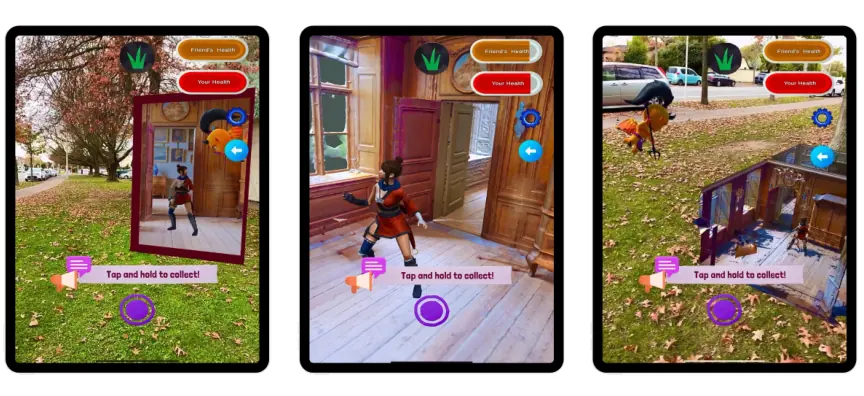
Three tablets showing the same remote room rendered three ways in AR: as a Window portal in a park, as a full-scale Overlay, and as a Tabletop miniature on the grass
Study 1's three display techniques, left to right: Window, Overlay and Tabletop.

What we found

  • Overlay produced the strongest sense of “being there”; Window felt like the remote place extending into your own; Tabletop gave a detached, strategic overview.
  • AR changed how people played: players used mid-air and vertical space, and a lightweight cue showing where the remote player was looking strengthened social connection — without avatars or video.
  • Interactive AR mechanics deepened strategic search and engagement, when paired with clear feedback and well-calibrated constraints.
128participants across three user studies
5peer-reviewed articles, including IEEE VR, OzCHI and Elsevier's Entertainment Computing
4design-guideline themes, now a free playbook
If you're facing something similar

If people in different places need to share one experience — remote training, tourism and heritage, family play, distributed teams — the same principles tell you what to render, what to leave out, and where AR genuinely earns its place. Read the AR Design Playbook, or start with an XR Opportunity Sprint.
Full research and publications →  ·  PhD thesis ↗

Case study 02 · EdTech & learning design

YooBees: a classroom students don't want to skip

Static slides and paper registers weren't working for an international postgraduate cohort. So I built the platform the classroom needed — then rebuilt four courses as interactive lessons anyone can open.

The problem

A master's cohort spanning 24 countries brings different expectations, different starting points and, at times, dishonest attendance submissions from shared devices or from off campus. Textbook drills lost the room, and as the lecturer I had no real-time picture of who was engaged and who was quietly falling behind.

What I did

  • One-tap attendance with three fraud checks running in real time: shared-IP clustering, GPS outliers more than 500 m from campus, and check-ins within 30 seconds of a session opening.
  • A live playground for running SQL and Python inside the lecture, and SQL Race — a multiplayer competition where students only advance by writing a correct query.
  • Quiz badges across 100+ questions, a daily match pairing students across cohorts, and a lecturer analytics dashboard.
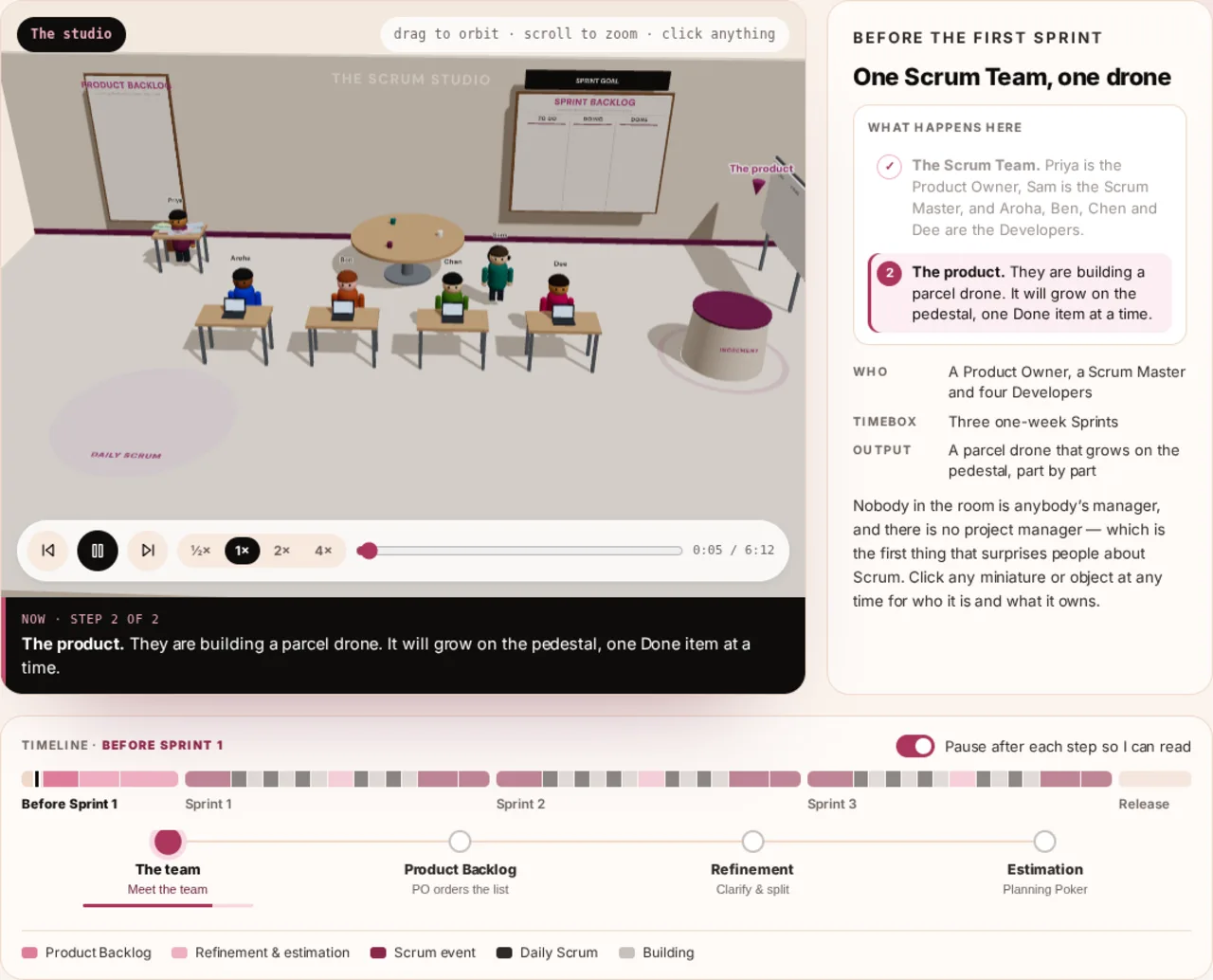
  • Then I rebuilt four courses — strategy, databases, project management and data analytics — as 39 interactive lessons, labs and study packs, including a 3D Scrum studio and a deliberately insecure shop with twenty hidden vulnerabilities to find.
The 3D Scrum studio lesson: miniature figures of a Scrum team around desks and a product backlog wall, with a timeline of three Sprints below
The Scrum studio from MBI804 — a Sprint you can watch, pause and orbit, in the browser.

What came out of it

The clearest lesson was about motivation: students who were bored by textbook drills became intensely focused the moment there was a leaderboard. Rigour stayed — students only move forward by getting it right — but failing became one more lap rather than a verdict.

228students from 24 countries on the platform
2,500+attendance records logged
39lessons, labs and study packs across four courses
If you're facing something similar

Engagement and academic integrity don't have to be traded against each other. If your institution is redesigning courses, adding gamified or AI-assisted learning, or choosing a platform, see EdTech & Engaged-Classroom Advisory — or try the workshops built from these lessons.

More about YooBees →  ·  Open the lessons →

Case study 03 · Product & venture

ICT Campus: building a bilingual online school

Founding, building and teaching an online classroom for Sri Lankan students — from free study pages that earn trust, to live classes, to a new programme that carries students into university.

The problem

Good A/L ICT teaching in Sri Lanka is unevenly spread, and many students are far from it or want it in their own language. After the exam comes a long wait before university — and first-year students arrive expected to use tools and research skills that nobody taught them.

What I did

  • An online classroom covering the full NIE syllabus: live Zoom classes with recordings, real-time class chat, timed mock exams and a browser-based Code Lab, with a Sinhala and English interface.
  • Free public study pages — the syllabus, past papers, a guide to life after A/Ls, university Z-score cut-offs — that help students before they ever pay, and bring them in through search.
  • Campus Ready, a 12-week programme for the gap before university: Moodle, Excel, Python and pandas, statistics, Power BI, referencing and ethical AI use, ending in a capstone dashboard on real Sri Lankan open data.

It builds on earlier work at the University of Moratuwa, where I led the Software Engineering strand of an open learning platform that grew to more than 150,000 registered learners — many of them far from any campus.

100%of the NIE A/L ICT syllabus, in two languages
12 weeksCampus Ready, with two intakes a year
150K+learners on the MOOC platform that came before it
If you're facing something similar

Launching a programme in a new market, teaching in more than one language, or turning free content into a paid offer? The same approach — trust first, then a product people choose to pay for — works for training providers and colleges. Let's talk.

Visit ICT Campus ↗  ·  Campus Ready ↗

Your project

Have a problem that needs research, a build — or both?